
© 2026. Randolph Hub. All Rights Reserved.
Welcome!
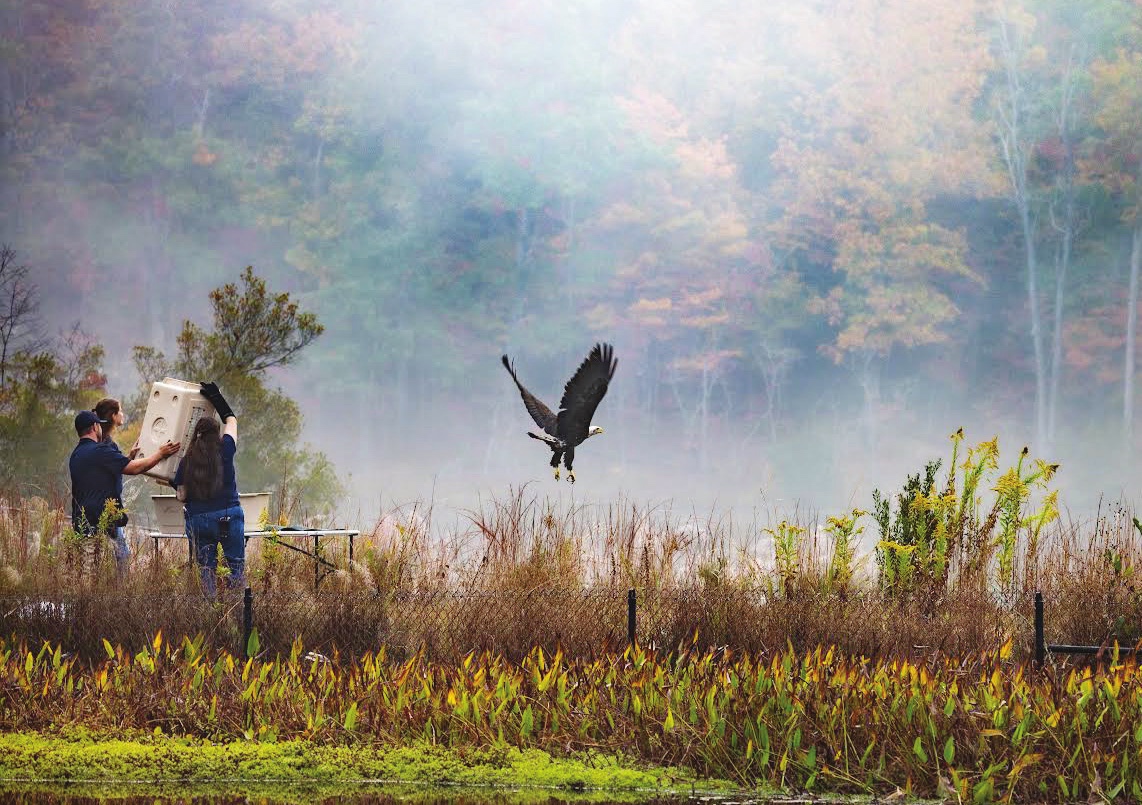
After Wildlife Rehab Center staff members lift the lid from the enclosure, this 4-year-old eagle took advantage of her freedom, slowly lifting off before flying into the mist, headed toward a wooded area. (Photo: NC Zoo)
Wildlife Rehab Center celebrates 25 years with release of healed eagle
ASHEBORO — A bald eagle leaped to freedom, rising into the misty skies over the NC Zoo’s North America Lake before disappearing into trees. The flight exemplified the mission of the Valerie H. Schindler Wildlife Rehabilitation Center, which just happened to be celebrating its 25th anniversary.
The private event for zoo staff and media took place Nov. 4 beginning at the Dragonfly Pointe picnic area for the release of the female bald eagle. From there, attendees moved to the nearby Solar Pointe picnic area for refreshments.
 Halley Buckanoff, supervisor of the Wildlife Rehabilitation Center (WRC), said the eagle, estimated at 4 years of age, had been brought in on Sept. 9 from a local landfill. “She was barely responsive when she came in,” Buckanoff said. Under WRC’s care, the eagle’s stamina slowly built up, and she was able to eat an eagle diet.
Zoo Director Mark Penning said to members of the WRC staff, “I have one word to sum it up — hope. She bounced back and it wouldn’t have happened without the work you do. It’s a message of hope, that’s what it means to all of us.”
Buckanoff told the group that came to watch the eagle’s release that she’s “seen at least 10,000 animals” cared for at the WRC. “They’re our wildlife neighbors. It helps that people care about their wildlife neighbors.”
She estimated that some 100 species of animals have come in for care, from injuries, sickness or orphaned young.
The WRC began helping animals in August 2001, “provid(ing) free, professional veterinary and rehabilitation services to sick, injured and/or orphaned native North Carolina animals for the sole purpose of returning them to the wild in a condition that will optimize their chances of survival after release,” according to information provided by the zoo.
Trained volunteers are the primary staff of the WRC, augmented by a limited number of zoo personnel and interns. Buckanoff was the first paid employee.
The Connecticut native had worked in a number of states before arriving at the WRC in 2007. She calls herself “a certified wildlife rehabber.”
She said, “When I first started, the WRC was seen as a hobby. We moved it to professional. I’ve worked with facilities all over the world and we’ve published articles.”
Buckanoff, noting that the WRC uses mostly volunteers, said, “This is an opportunity for people wanting to get into animal care. It’s not pretty but it’s what animals need.”
She said she tries to talk annually to students in the NC Zoo School and that a few of them become WRC interns.
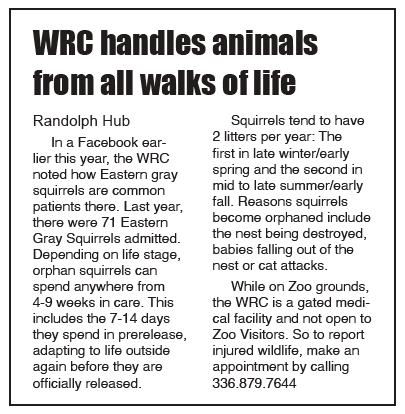
According to the zoo, the WRC team has “nurs(ed) various species — from squirrels and snakes to birds and black bears — back to health. … We now see around 1,000 animals in a given year. Volunteers and interns are relied upon for the care and husbandry of sick, injured and orphaned native wildlife, until they are ready for release back into the wild, as well as caring for our education animals. Duties include but are not limited to feeding animals, preparation of diets, cleaning enclosures, admitting patients, answering phones, and record keeping.”