
© 2026. Randolph Hub. All Rights Reserved.
Welcome!
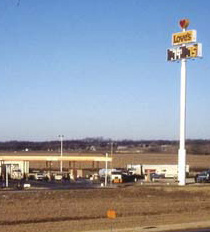
Love’s, which is coming to the Seagrove area, is known for its signs stretching into the sky. This sign looms over Love’s first travel stop opened in Amarillo, TX, on I-40 in 1981. (Photo: Lowe's Travel Centers Instagram)
Commissioners trying to work out signage rules; 1987 rules are outdated
ASHEBORO — Randolph County Board of Commissioners asked the planning board to revise four proposed regulations on sign displays before they approve a revised Unified Development Ordinance (UDO).
The review has been continued multiple times, and commissioners continued to debate whether the changes are too restrictive at their Feb. 9 meeting. (Their regular meeting was delayed by one week because of the winter storm that hit North Carolina on Jan. 31.)
UDO still not settled
Commissioner Chair Darrell Frye acknowledged that planning staff, working with the new director Kim Heinzer, have spent a long time trying to update the county’s rules on signage, but he still had points of contention.
“This is an important part of our ordinance,” Frye said. “I was in that business for almost 14 years. We used to always say a business without a sign is a sign of no business.”
Heinzer said the changes will address size and height, limits per land plot, and how far signs must be spaced from one another and from residential setbacks. She said the current sign ordinances, written in 1987, are too outdated for the current requests coming before the planning board.
The proposal divides signs by purpose:
■ Church and public building signs.
■ Commercial business park identification signs.
■ Government signs.
■ Home occupation and office signs.
■ Marquee, principal use, projecting, roof, suspended, or wall signs.
■ Off-premise directional and informational signs.
■ Billboards, i.e. outdoor advertising signs.
■ Subdivision identification signs.
■ Informational/promotional (temporary), agricultural product, and real estate signs.
Heinzer said individuals will be able to request an exemption if their sign is outside the limits. Frye said the new Toyota manufacturing plant is one example of a business that did not conform to the signage rules, and the upcoming Loves Truck Stop will likely ask for exemptions.
Among his critiques, Frye said a 300-foot setback from residentially zoned property was far more restrictive than the state’s. He also disagreed with limiting one billboard per lot. He said some farms and other properties are so large, they should be allowed to have more than one billboard if they can space them 1,000 feet apart.
Commissioner Kenny Kidd took issue with the proposal to remove real estate signs within seven days of sale, saying a “SOLD” sign is part of a realtor’s marketing.
He also felt the UDO might drive off business, he said, “if I can go down the road to Lee County, and that’s less restrictive, if I can just move on down there to that part of 421 and do business with that farmer. I want to be friendly to the property owners who need or want business.”
Commissioner Lester Rivenbark also argued it could create problems for neighbors who both want signs. “It feels like we’re picking winners and losers for who can make money off their property,” he said.
Commissioner Hope Haywood said the new changes balance growth and rural character. “We take pride in being an agricultural county, wanting to preserve land,” she said. “With adding billboards, we have to wonder what is appropriate, and specific businesses can ask for permission.”
She went on to say, “Just because you have a piece of property doesn’t mean you can do what you want with it.”
County Attorney Ben Morgan advised the commissioners that they could vote on the proposal as it was, or they could send it back with specific recommendations.
They asked the board to review the distance between billboards, decrease the residential setback from 300 to 150 feet, allow for multiple billboards on a property with large frontage, and ease the removal of a real estate sign from seven days after sale to 30.
Library board supporters present petition
During the public comment period at the Feb. 9 meeting, critics of the Board of Commissioners’ vote to remove the library board of trustees presented their petition to reinstate them.
Susie Scott of Asheboro said they had 700 signatures, 500 confirmed to be Randolph County residents. The petition said the trustees served responsibly and with integrity, and the First Amendment protects access to reading materials without deference to religion. It said removing the board would set a precedent that public pressure can override laws.
Virginia Wall of Asheboro argued that the push to remove the children’s book “Call Me Max” came from a group outside Randolph County. Jennifer Eagle said the board was unfairly punished for protecting their policies.
Carl Hicks, a regular speaker at public comment periods, did not specifically address the library decision this month, but he said he wants to see more civility in public discourse.
The commissioners voted 3-2 to remove the board in December following criticism of “Call Me Max,” which is about a child identifying as a transgender boy. In October, the library board upheld keeping the book after a public hearing for critics and supporters. Opponents said its topic was inappropriate for children, with others recommending it go in a non-children’s section so parents could be prepared to address its themes.
Commissioners take up regular business
■ Commissioners voted 4-1 a budget amendment for a contract to start a food hub at the Agricultural Center. Kidd was the dissenting vote.
The contract for $74,100 will come out of strategic funds paid annually by Waste Management.
Frye said he knew there were still questions about how the food hub will function, but after talking with members of the agricultural community, there was consensus to move forward. “We’ve never done this before,” he said. “We won’t know if we’re getting it right until it’s done.”
Haywood said they reviewed food hubs in other counties, and it took them two or three years to get established. She said, “That’s part of the work, helping people understand how it benefits them.”
The contract will go to NC Rooted Community Agriculture, Inc., a new non-profit by farmers Lindsey and Robert Poe.
n Public Health Director Tara Aker presented the report on child deaths in 2024. She said the Local Team, a combined force of the Community Child Protection Team and the Child Fatality Prevention Team, received 20 reports.
The report covers minors up to the age of 18. Aker said they consisted of four accidents, two from birth defects, five illnesses, five perinatal conditions, one suicide, two homicides, and one undetermined cause.
Aker said the Local Team’s regular membership has grown to about 20 people. It is made up of partners from the Department of Social Services, Public Health, the sheriff’s office and district attorney’s office. Two members were trained to enter case reviews into the National Fatality Review-Case Reporting System. They reviewed 24 cases in 2025, including some from prior years with pending reports from the medical examiner.
Frye asked how many local calls came through the suicide prevention hotline 988. Aker said they don’t have the call volume.
■ Human Resources Director Jill Williams presented changes to the employee policies and procedures manual. Her staff worked with Teague Campbell to update it, making clarifications for grant-funded positions, the proficiency pay program, remote work, and post-accident (vehicle) drug and alcohol testing requirements. Commissioners approved the revisions.
■ Commissioners adopted a calendar for the 2026-27 budget:
— May 28, 6 to 7:40 p.m. — Proposed budget presentations, school systems and Randolph Community Colleges to make presentations.
— June 1, 6 p.m. — Regular commissioners meeting, Trillium Health Resources to make presentation.
— June 4, 3 to 5 p.m. — Public input, community agencies and fire departments to make presentations.
— June 15, 6 p.m. — Budget adoption and approval of close-out of this fiscal year’s budget amendments.