
© 2026. Randolph Hub. All Rights Reserved.
Welcome!
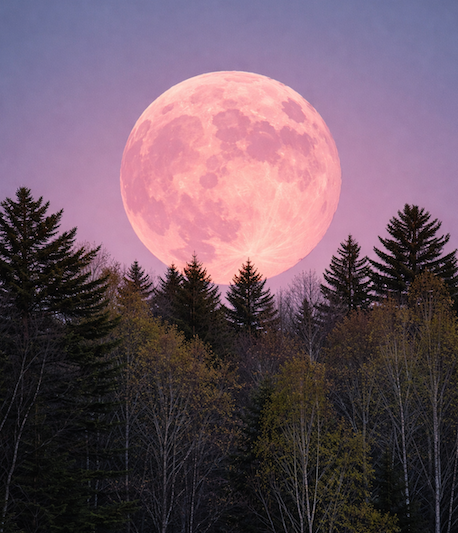
Illustration of pink moon – it won't REALLY be pink but it would look cool if it did.
SPACE CALENDAR: April in the skies
What to look for in the skies in April:
APRIL 1 (no foolin’)
Full Pink Moon
April’s Full Moon rises at 10:12 p.m. on April 1. It’s called the Pink Moon — not because it turns pink, but because it coincides with the blooming of wild creeping phlox, one of the first wildflowers of spring across eastern North America. In European traditions, it goes by the Egg Moon or Seed Moon, both marking the arrival of planting season. This year it also serves as the Paschal Moon — the first Full Moon after the spring equinox — which is used by the Christian calendar to set the date of Easter. Since it falls on a Wednesday (April 1), Easter lands on the following Sunday (April 5).
APRIL 15-17
Comet C/2025 R3 (PanSTARRS) — A Once-in-a-Lifetime Visitor
Discovered on Sept. 8, 2025, by PanSTARRS — a pair of 1.8-meter reflector telescopes atop Hawaii’s Haleākalā volcano — Comet C/2025 R3 is an Oort Cloud traveler making what is almost certainly its first and only pass through our inner solar system. It will not return in our lifetimes, if ever.
By April 15–17, the comet is predicted to reach magnitude 3.4 to 3.8 — bright enough to see with the naked eye from a dark site — while still sitting high enough above the eastern horizon to find in the pre-dawn sky. The New Moon falls on April 17, leaving those nights completely moonless and ideal for viewing. Look low in the east in the constellation Pisces about 45 minutes before sunrise. With binoculars you should see a distinct coma and possibly a tail.
After April 17, the comet continues to brighten but drops rapidly toward the Sun, making it increasingly difficult to spot from central North Carolina.
Dark skies away from city lights, like those found in and around the Uwharrie National Forest — south of Asheboro — offer your best chance to see the comet.
APRIL 22-23
Lyrid Meteor Shower Peak
Active from April 16 through April 25, the Lyrids peak on the night of April 22–23. One of the oldest known meteor showers — recorded by Chinese astronomers over 2,700 years ago — the Lyrids produce up to 15–20 meteors per hour under dark skies, with occasional bright fireballs leaving lingering glowing trails.
The radiant lies near the brilliant star Vega in the constellation Lyra, which climbs high in the northeast sky after midnight. For central North Carolina, the best viewing window is from about 11 p.m. onward, with the most meteors appearing in the hours before dawn.
Viewing conditions this year are excellent. The nearly new Moon sets early in the evening, leaving the sky fully dark. Find an open area away from city lights, allow 20 minutes for your eyes to adjust, lie on your back facing up, and sweep the whole sky — meteors can appear anywhere.
APRIL 25
Occultation of Regulus by the Moon
On the night of April 25, the Moon passes directly in front of Regulus — the brightest star in Leo — causing it to abruptly disappear, then reappear, in what astronomers call a lunar occultation. The event occurs between 8 and 10 p.m. EDT for eastern North Carolina, though exact timing varies by location. Check a local astronomy app for precise times.
MOON PHASES
■ Full Moon: April 1 —10:12 p.m.
■ Last Quarter: April 9 – 1:39 a.m.
■ New Moon: April 17 – 12:54 a.m.
■ First Quarter: April 24 – 8:32 p.m.